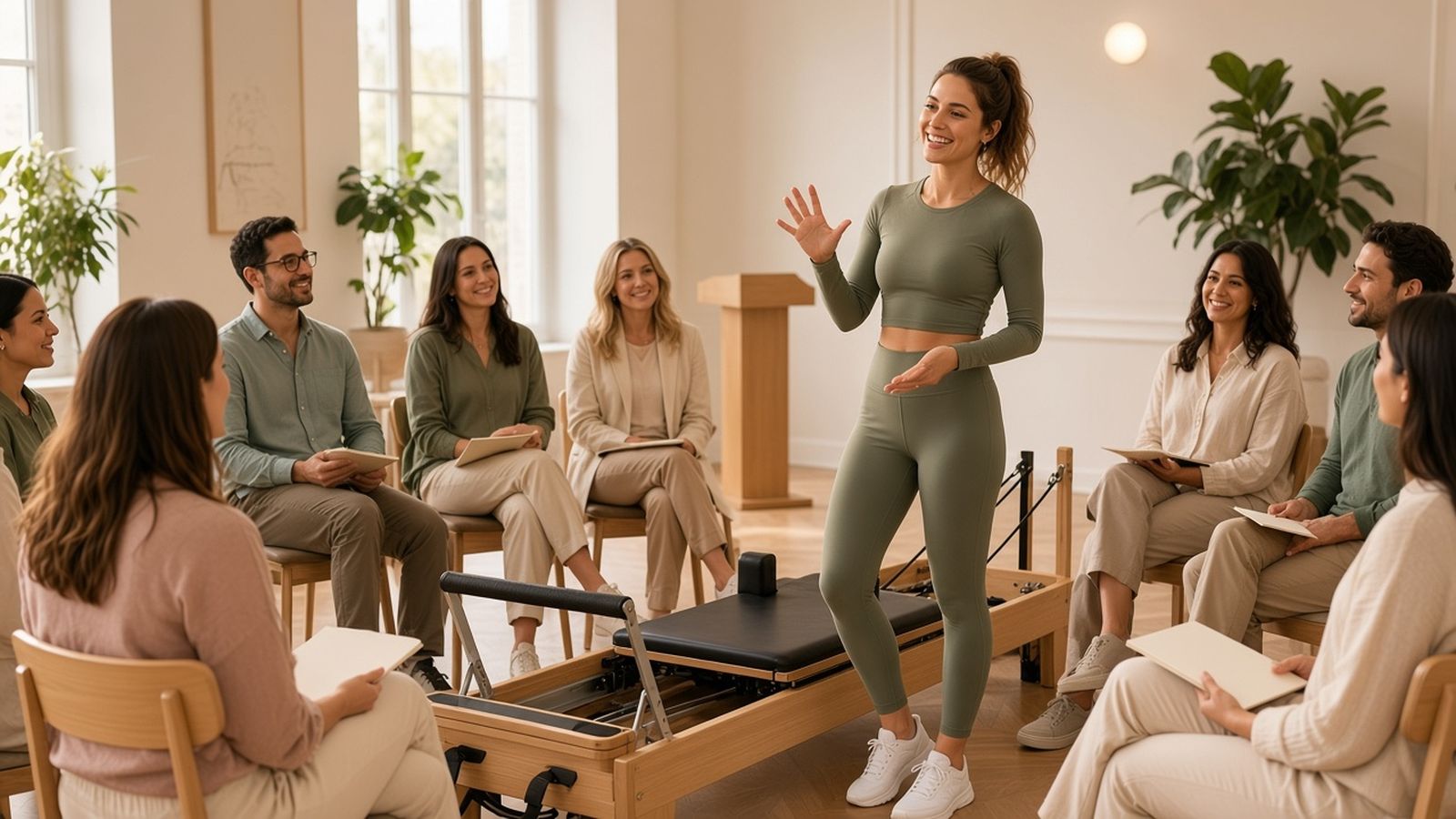
Pilates is a practice with many entry points. This guide offers useful context without making the experience more complicated than it needs to be.
Start with your own practice
Most teacher training programs expect you to arrive with some experience of the method, and for good reason: teaching what you have not practiced is difficult. Before enrolling, take classes regularly, try both mat and apparatus, and experience more than one studio and teaching style. Notice what you value in a teacher, because those observations become the standard you will teach to.
Use this phase to explore the field. Attend a classical and a contemporary class, watch how different instructors handle mixed-level rooms, and talk with teachers about their training and their work. This costs little and gives you the clearest picture of what the career actually involves day to day.

Choosing a training pathway
The main fork in teacher training is mat-only versus comprehensive. A mat program is a focused entry point: it covers foundational principles, mat repertoire, anatomy, cueing, and practice teaching, usually over a shorter timeline. A comprehensive program adds the apparatus — reformer, Cadillac, chair, and barrels — and takes considerably longer, with more observation, practice teaching, and assessment.
Neither path is universally right. Mat-only training suits people who want to teach group fitness or add Pilates to an existing movement career, or who want to explore teaching before committing to a full program. Comprehensive training is the standard expectation for studio apparatus teaching. Our certification guide compares programs, hours, and well-known providers in detail.
Questions to ask a training program
Ask what the advertised hours include, how practice teaching and observation are structured, who assesses you, what the total cost covers, and what support exists after graduation. Ask to speak with graduates. A program that answers these questions readily is off to a good start.

Certification and what follows
Completing a program earns you a certificate from that provider. The Pilates field does not have a single universal licensing requirement in the way some professions do; employers, insurers, and clients look at your training, your experience, and sometimes additional credentials. Understand what your certificate represents and what local employers expect before you begin applying.
Plan for continuing education from the start. Specialty populations — prenatal clients, older adults, people managing injuries — require additional training beyond a foundational certificate, and the best teachers treat learning as permanent. Budget time and money for workshops and further study as part of the career, not as an optional extra.
Practice teaching and mentorship
The gap between knowing an exercise and teaching it is large, and practice teaching is where it closes. Teach friends and fellow trainees early and often. Record yourself when you can, watch it back, and notice the difference between what you said and what you meant. Concise, useful cueing is a craft built through repetition.
Mentorship accelerates everything. Find an experienced teacher willing to observe your classes and give specific feedback — not just praise. Ask about pacing, transitions, modifications, and how they manage a room. Most good teachers remember being mentored and are willing to pay it forward; you usually only have to ask.
Finding your first teaching work
Most careers begin in studios and gyms: covering classes, teaching unpopular time slots, and building a reputation one session at a time. Apply with your training and availability, be honest about your experience, and accept that early work is about accumulating hours and feedback rather than maximizing income. Reliability matters as much as repertoire; studios remember instructors who show up prepared.
Some instructors also teach privately, in clients’ homes, or in community and wellness settings. Each setting has its own expectations around preparation, professionalism, and scope. Whichever you choose, keep clear boundaries about what you teach: instructors teach movement and refer medical questions to qualified professionals.
The practical and financial side
Teaching Pilates is a real career with real economics. Studio instructors are typically paid per class or per hour, with rates varying by city, format, and experience. Private work pays more per hour but requires building a client base. Many instructors combine studio classes with private clients, and income often grows over years as reputation and clientele develop.
Understand the costs as well: training tuition, insurance, continuing education, and the unpaid hours of practice and preparation. Ask working instructors how they structured their first years. A clear-eyed picture of the economics is not discouraging; it is what allows you to build a teaching life that lasts.
Building a sustainable teaching life
The instructors who last are the ones who protect their own practice and their own energy. Keep taking classes as a student, keep your own body conditioned, and manage your schedule so that teaching remains something you enjoy rather than something you survive. Burnout is a known risk in bodywork professions, and it is managed by realistic scheduling, not by willpower.
Sustainability also has a professional dimension. Keep your training records, liability insurance, and certifications current in a single place, and renew them before they lapse rather than scrambling afterward. Check whether any continuing-education requirements apply to your employer or insurer, and treat them as annual maintenance rather than an emergency. Instructors who stay organized tend to move smoothly between studios as their careers grow.
Finally, remember why the work is worthwhile. Teaching Pilates means helping people understand their own movement, often at moments when they are rebuilding confidence or health. It is a career of attention and craft. Approach training with curiosity, choose a program that makes you more observant and responsible, and let the teaching develop at the pace your life supports.
Helpful next reads
Find a studio near you.
Explore local studios and choose a place that fits your schedule, questions, and way of moving.
FAQ
How long does it take to become a Pilates instructor?
It depends on the pathway. Mat programs may take a few months; comprehensive apparatus programs often take a year or more including practice teaching and assessment.
Do I need a certification to teach Pilates?
In practice, yes. Studios and insurers expect completion of a recognized training program, and clients rely on it as evidence of competence.
How much does Pilates teacher training cost?
Costs vary widely by provider, format, and pathway. Ask what tuition includes — materials, observation, assessment fees, equipment access — before enrolling.
Can I teach Pilates with a mat-only certification?
You can teach mat work within your training’s scope. Studio apparatus teaching generally requires comprehensive training; check the expectations of employers you want to work with.
How do I get my first Pilates teaching job?
Apply to studios and gyms with your training and availability, take class coverage and early time slots, and build experience and reputation over your first year of teaching.